






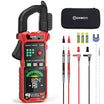
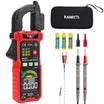
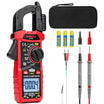

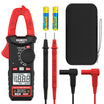








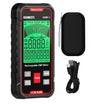











If a multimeter's current function has stopped working, a blown internal fuse may be the reason. The tempting question is whether to replace it with a ceramic or glass fuse. For a multimeter, however, the safe answer is: use only the exact replacement fuse specified by the meter manufacturer, including its part number or every stated electrical rating. Do not choose by appearance alone.
What is the difference between a ceramic and a glass multimeter fuse?
The body material affects how the fuse can contain heat and an electrical arc when it opens, but it is only one part of the fuse's safety design.
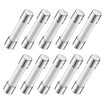
Glass cartridge fuses
A glass fuse has a transparent tube, so its element may sometimes be visible. This can make a broken element easier to spot, although a visual check is not reliable enough to prove that a fuse is good. Glass construction is often associated with lower-breaking-capacity fuse ranges.
Ceramic cartridge fuses
A ceramic fuse has an opaque tube and may be built for higher breaking capacity. Some high-energy fuses use a filler material to help control the arc created when the fuse opens under a severe fault. Ceramic bodies are therefore common in many higher-rated multimeter current inputs.
The important limitation
Neither label is a complete safety rating. Glass and ceramic cartridge fuses are available in different breaking-capacity classes, including common 5 mm × 20 mm sizes. The actual capability belongs to the specific fuse series and its datasheet, not to the word “ceramic” by itself. A ceramic fuse with the wrong rating can still be unsafe in your meter.
Why the fuse body is not the deciding factor
A multimeter fuse protects the current-measurement circuit when the meter is connected incorrectly or a current fault occurs. It must open safely at the available fault current, not merely fit the fuse clips.
Before a fuse can be considered an equivalent replacement, all of these characteristics need to match the meter's specification:
| Requirement | Why it matters |
|---|---|
| Manufacturer part number | The simplest and most reliable way to preserve the safety design when one is provided. |
| Current rating | A higher value may fail to protect the meter; a lower value may blow during normal use. |
| Voltage rating | The fuse must be rated for the voltage and type of circuit the meter is designed to measure. |
| Breaking or interrupt rating | This is the maximum fault current the fuse can safely interrupt. It is especially important for mains and distribution circuits. |
| Speed characteristic | Fast-acting and time-delay fuses respond differently. Substituting one for the other changes protection. |
| Physical size and end-cap style | A fuse must fit correctly, but matching dimensions alone does not establish electrical equivalence. |
When is a ceramic fuse usually the right choice?
A ceramic fuse is usually the right choice only when the multimeter manual or the original fuse calls for that specific high-breaking-capacity fuse.
This is particularly important for a meter intended for higher-energy electrical environments. The US has nominal 120 V household branch circuits, while UK homes use nominal 230 V mains supplies; both can deliver substantial fault current. A meter's safety category and its fuse specification work together. Do not assume that a household setting makes an unapproved substitute acceptable.
If your meter specifies a ceramic, high-breaking-capacity, sand-filled, 600 V, 1000 V, or high-interrupt fuse, replace it with the exact approved part. Do not replace it with a same-size glass fuse just because its amp rating looks similar.
Can you replace a ceramic multimeter fuse with a glass fuse?
Usually, no. Replacing a specified ceramic high-energy fuse with a glass fuse can reduce the meter's ability to interrupt a serious fault safely.
The reverse is not automatically acceptable either. A ceramic fuse may physically fit where a glass fuse was used, but it can still have the wrong current rating, speed, voltage rating, or interrupt rating. The correct replacement is determined by the manual and marking for your exact meter model, not by an upgrade or downgrade rule.
How to identify the correct multimeter fuse
The safest way to identify a replacement is to start with the exact model's official manual and match its listed fuse specification.
- Stop using the current function. If the fuse has blown, do not try to work around it or continue measuring current.
- Find the exact meter model. Check the front panel, rear label, battery cover, or original paperwork. A similar-looking model may use a different fuse.
- Read the official manual or service documentation. Look for “replacement fuses,” “maintenance,” or a parts table. Prefer the manufacturer part number where it is provided.
- Match every listed rating. Confirm current, voltage, speed, interrupt rating, dimensions, and part number before buying.
- Use an authorised or reputable electronics supplier. Keep packaging and compare the printed markings with the specification.
- Follow only the manufacturer's replacement procedure. Remove test leads and disconnect the meter from every circuit before opening it. If the manual does not describe user replacement, have the meter serviced.
If the manual is unavailable, the safe choice is to contact the manufacturer or replace the meter. Do not infer the fuse specification from a photograph, a marketplace listing, or a generic fuse assortment.
What does it mean if the replacement fuse blows again?
A replacement fuse that blows again is a signal to stop and investigate the measurement setup or have the meter checked; it is not a reason to fit a larger fuse.
Common causes include using the current input to measure voltage, leaving a test lead in an amperage socket, measuring current across a voltage source rather than in series with a load, or an internal meter fault. For someone new to electrical work, mains-circuit current measurements are a poor place to learn. A plug-in energy monitor, a clamp meter used as directed, or help from a qualified electrician may be safer for the task.
How to tell whether a multimeter fuse is blown
A visible broken element in a glass fuse can suggest failure, but the reliable method is the fuse-test procedure in your meter's manual.
Some meters let you check their internal current fuses from the outside using a specified resistance or continuity test. Other models require the case to be opened. Use the procedure for your exact model because probe sockets, expected readings, and fuse arrangements differ. Never test resistance or continuity on an energised circuit.
Bottom line
Ceramic fuses often provide the higher fault-interruption capability needed by many multimeters, while glass fuses are often found in lower-breaking-capacity ranges. But “ceramic versus glass” is not a valid replacement rule. Match the exact manufacturer-specified fuse, including its interrupt rating and speed, or do not replace it yourself.
Frequently asked questions
Are ceramic fuses better than glass fuses for multimeters?
Ceramic fuses are not universally better. They are often used where higher breaking capacity is required, but the correct fuse is the one specified for the exact multimeter model.
Can I use a fuse with the same amp rating if it fits?
No. A matching amp rating and size do not confirm matching voltage rating, speed, interrupt rating, or manufacturer approval.
Why is the interrupt rating important?
The interrupt rating indicates the fault current a fuse can safely break. A multimeter can face much more fault current than its normal measurement range suggests, especially when connected to mains or distribution circuits.
Is it safe for a homeowner to replace a multimeter fuse?
It can be, but only when the manufacturer describes it as a user-replaceable part and you can install the exact specified fuse with the meter disconnected from all circuits. If you cannot verify the part or procedure, use professional service or replace the meter.

Leave a comment
All comments are moderated before being published.
This site is protected by hCaptcha and the hCaptcha Privacy Policy and Terms of Service apply.