


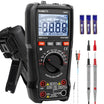

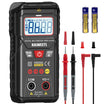
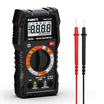

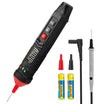









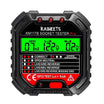
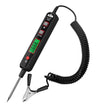
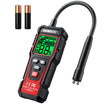
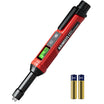
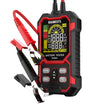
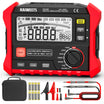
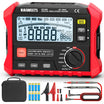
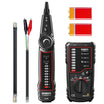













True RMS is a measurement method that determines the effective value of an AC waveform by accounting for its actual shape. RMS stands for root mean square: square the instantaneous values, calculate their mean, and take the square root.
The result represents the DC voltage or current that would produce the same average heating effect in an ideal resistive load. The word true distinguishes this method from average-responding instruments that estimate RMS by assuming the waveform is a pure sine wave.
A True-RMS instrument can measure both sinusoidal and many non-sinusoidal waveforms accurately, provided the signal remains within the instrument's range, bandwidth, crest-factor limit, and other published specifications.
What Does True RMS Mean?
RMS is short for root mean square. The name describes the three mathematical steps used to calculate it:
- Square: Square each instantaneous voltage or current value.
- Mean: Find the average of the squared values over the measurement interval.
- Root: Take the square root of that average.
Squaring serves two purposes. It prevents negative portions of an AC waveform from canceling positive portions, and it reflects the relationship between voltage, current, and heat in a resistive load. Taking the final square root returns the result to the original unit, such as volts or amperes.
The term “True RMS” can sometimes cause confusion because it sounds like a separate electrical quantity. It is not. There is only one mathematically defined RMS value for a specified waveform and measurement interval. “True RMS” generally describes an instrument that determines that value without relying on the assumption that the input is a pure sine wave.
Why Is RMS Used for AC Measurements?
RMS provides a practical way to compare changing AC quantities with steady DC quantities. If an AC voltage and a DC voltage have the same RMS value, they produce the same average power in an ideal resistor.
For a resistive load, average power can be expressed as:
P = VRMS2 / R
It can also be expressed in terms of current:
P = IRMS2 × R
This heating relationship is why conductors, fuses, bus bars, and thermal elements in circuit breakers are commonly rated using RMS current.
For example, the nominal voltage supplied by a standard U.S. household receptacle is approximately 120 V RMS. A pure 120 V RMS sine wave has a peak value of about 170 V. Calling it “120 V AC” refers to its RMS value, not its peak.
RMS voltage and RMS current should not be confused with power. There is no separate electrical quantity called “RMS power.” Calculating real power in an AC circuit may also require the phase relationship between voltage and current and the instantaneous waveform product. Multiplying RMS voltage by RMS current gives apparent power in volt-amperes, not necessarily real power in watts.
How Is True RMS Calculated?
For a continuous periodic waveform x(t), its RMS value over one period T is:
xRMS = √[(1 / T) ∫0T x2(t) dt]
A digital instrument works with samples rather than a perfectly continuous waveform. For n equally spaced samples, the corresponding calculation is:
xRMS = √[(x12 + x22 + … + xn2) / n]
The exact implementation varies by instrument. A meter may use an analog RMS converter, digital sampling, or a combination of techniques. What matters to the user is whether the instrument can produce a valid RMS result for the waveform within its stated operating limits.
RMS of a Pure Sine Wave
For a pure sine wave, the relationship between its peak and RMS values is:
VRMS = Vpeak / √2 ≈ 0.707 × Vpeak
If the starting value is peak-to-peak voltage:
VRMS = Vpeak-to-peak / (2√2)
These shortcuts apply only to a pure sine wave. They should not be applied indiscriminately to square waves, triangle waves, pulse trains, clipped signals, or pulse-width-modulated waveforms.
Different Waveforms Have Different Relationships
| Waveform | RMS value | Crest factor |
|---|---|---|
| Pure sine wave | Peak / √2 | Approximately 1.414 |
| Symmetrical square wave | Equal to peak | 1 |
| Symmetrical triangle wave | Peak / √3 | Approximately 1.732 |
| Pulse train | Depends on amplitude and duty cycle | Increases as the duty cycle becomes smaller |
This is the central reason True-RMS measurement matters: the relationship between peak, average, and RMS values changes with waveform shape.
Sine Waves vs. Non-Sinusoidal Waveforms
A sinusoidal waveform, commonly called a sine wave, changes smoothly and predictably. Utility voltage is intended to approximate this shape. Traditional resistance heaters, incandescent lamps, and some other linear loads also draw current in a relatively smooth form.
A non-sinusoidal waveform does not follow the shape of a pure sine wave. It may be distorted, clipped, pulsed, switched, or affected by harmonics. Modern electronic loads frequently draw current only during limited portions of each AC cycle, producing narrow current pulses instead of a smooth curve.
Common sources of non-sinusoidal signals include:
- Switch-mode power supplies
- Computers and servers
- LED drivers and electronic ballasts
- Dimmers and phase-control circuits
- Variable-frequency drives
- Inverters and uninterruptible power supplies
- Electronic HVAC controls
- Battery chargers and rectifiers
- Industrial automation equipment
- Solar power and energy-storage systems
| Waveform | Typical source | Measurement implication |
|---|---|---|
| Pure or nearly pure sine wave | Utility AC supplying a linear load | A suitable average-responding instrument and a True-RMS instrument should give similar readings. |
| Distorted AC waveform | Nonlinear electronic load | A True-RMS instrument is normally preferred. |
| Pulse-width-modulated waveform | Variable-frequency drive or switching circuit | The measurement may require a low-pass filter, a suitable bandwidth, or specialized equipment. |
| Waveform with a DC offset | Asymmetrical pulse train or mixed AC/DC signal | The result depends on whether the instrument measures AC RMS or AC+DC RMS. |
| Signal containing brief transients | Switching, arcing, or load changes | A numerical RMS reading may not reveal the transient; an oscilloscope or power-quality analyzer may be needed. |
True RMS vs. Average-Responding Measurement
An average-responding AC meter usually rectifies the waveform, measures its average magnitude, and multiplies the result by approximately 1.11. This conversion factor represents the fixed relationship between the rectified average and RMS values of a pure sine wave.
When the input is a clean sine wave, this method can be accurate and economical. When the waveform is not sinusoidal, the relationship no longer remains fixed. The instrument may display a value that is too low or too high.
A True-RMS instrument evaluates the waveform using a method that accounts for its actual shape. This enables it to measure many distorted signals more accurately than an average-responding instrument.
| Feature | True-RMS instrument | Average-responding instrument |
|---|---|---|
| Basic method | Determines RMS from the measured waveform | Measures rectified average and applies a sine-wave conversion factor |
| Pure sine wave | Accurate within published specifications | Accurate within published specifications |
| Distorted waveform | Usually accurate when the signal remains within instrument limits | May produce substantial error |
| Measurement limits | Range, bandwidth, crest factor, coupling, and accuracy specifications still apply | Accuracy depends heavily on how closely the signal resembles a sine wave |
| Typical use | Electronic, industrial, HVAC, commercial, and unknown AC signals | Known and stable sine-wave applications |
“Average responding” does not mean poorly made or inherently inaccurate. It describes the measurement method. Such an instrument may work well when its sine-wave assumption is valid. The problem arises when a user applies that assumption to a waveform that does not support it.
Which Instruments Can Measure True RMS?
True RMS is a measurement capability, not a category of instrument. It may appear in portable field tools, laboratory instruments, power-analysis equipment, and computer-based measurement systems.
| Instrument | Best suited for | Important qualification |
|---|---|---|
| True-RMS digital multimeter | General AC voltage and current troubleshooting | Confirm whether True RMS applies to voltage, current, or both. |
| True-RMS clamp meter | Measuring current without opening the circuit | The clamp normally goes around one conductor, not an entire multi-conductor cable. |
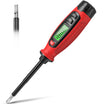
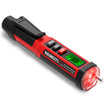
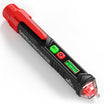
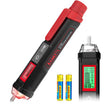
| True-RMS electrical tester | Fast field checks | It may provide fewer functions and ranges than a full multimeter. |
| Bench digital multimeter | Laboratory, production, and precision measurements | AC, AC+DC, bandwidth, and sampling options vary by model. |
| Power meter or power analyzer | Power-electronics testing and energy measurements | It can measure voltage, current, power, phase relationships, and related quantities. |
| Power-quality analyzer | Three-phase systems, harmonics, logging, and power-quality investigations | It provides more information than an RMS value alone. |
| Digital oscilloscope | Viewing waveform shape, PWM, noise, and transients | RMS results depend on the capture window, coupling, probe, bandwidth, sample rate, and settings. |
| Data-acquisition system | Automated testing, monitoring, and data logging | Valid RMS calculations require appropriate signal conditioning, sampling, bandwidth, and software configuration. |
True-RMS Digital Multimeters
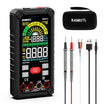
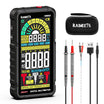
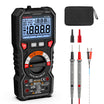
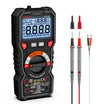
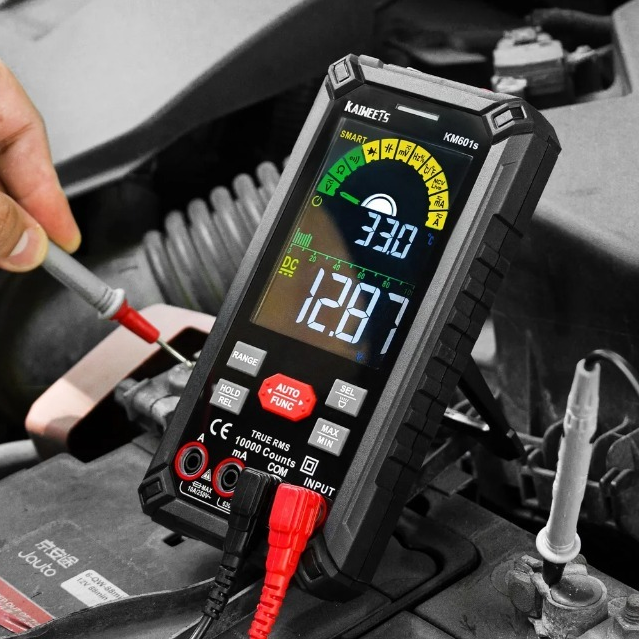
A True-RMS digital multimeter is the most familiar portable instrument in this group. Depending on the model, it may measure AC and DC voltage, AC and DC current, resistance, continuity, capacitance, frequency, temperature, and other quantities.
The True-RMS specification normally applies only to designated AC functions. It does not describe every function on the meter. Some models provide True-RMS AC voltage but lack an AC current range, while others provide True RMS for both voltage and current.
A multimeter is well suited to troubleshooting when the main goal is a stable numerical reading. It is less useful when the shape, timing, or transient behavior of the waveform must be examined directly.
True-RMS Clamp Meters
A clamp meter senses current through the magnetic field around a conductor. This allows current to be measured without disconnecting the wire and placing the meter in series with the circuit.
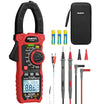
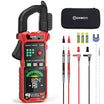
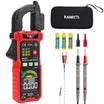
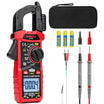
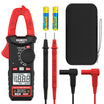
True-RMS clamp meters are especially useful for measuring distorted load current in commercial, HVAC, and industrial equipment. Some models measure only AC current, while others support AC and DC current and include test leads for voltage, resistance, and continuity measurements.
The clamp normally needs to surround one current-carrying conductor. If it surrounds both the outgoing and returning conductors, their magnetic fields largely cancel and the meter may read close to zero. Leakage-current testing is a separate application that may intentionally use a different clamping arrangement and a meter designed for that purpose.
Electrical Testers
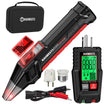
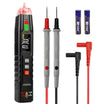
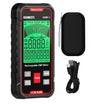
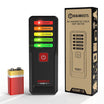
Some compact electrical testers provide True-RMS voltage or current measurements for fast field checks. They can be convenient for electricians who need a simpler tool than a full-featured digital multimeter.
Because their ranges, resolution, and functions vary, an electrical tester should not automatically be treated as interchangeable with a multimeter. Its specifications must still match the job.
Power and Power-Quality Analyzers
A power analyzer measures more than RMS voltage and current. Depending on the instrument, it may calculate real power, apparent power, reactive power, power factor, efficiency, phase relationships, harmonics, and energy consumption.
A power-quality analyzer is designed for investigating electrical distribution systems. It may record voltage sags, swells, interruptions, harmonic distortion, unbalance, inrush current, and other events over time. For three-phase systems or persistent power-quality problems, this information is often more useful than a single True-RMS reading.
When Do You Need a True-RMS Measurement?
Use a True-RMS measurement when the waveform may be distorted, when the load is nonlinear, or when the waveform shape is unknown. It is particularly useful in systems containing electronic switching or rectification.
Applications Where True RMS Matters
- Commercial buildings: Computers, office electronics, LED lighting, and electronic ballasts can create harmonic current.
- HVAC systems: Electronic controls, variable-speed compressors, and motor drives may produce distorted signals.
- Industrial facilities: Rectifiers, automation equipment, welders, motor drives, and solid-state controls often involve non-sinusoidal waveforms.
- Data centers: Large numbers of switch-mode power supplies can create pulsed current and harmonic loading.
- Solar and energy-storage systems: Inverters, chargers, and power-conversion equipment use high-speed switching.
- Backup-power systems: Some UPS and generator outputs may depart from a pure sine wave, especially under certain operating conditions.
- Unknown AC circuits: True RMS reduces reliance on an unverified sine-wave assumption.
When True RMS May Not Be Necessary
A True-RMS function may offer little advantage when you are measuring a verified, clean sine wave with a linear load. A properly calibrated average-responding meter can provide an accurate reading in that situation.
True RMS also provides no special benefit for continuity, resistance, diode testing, or ordinary steady DC measurements. Those functions use other measurement methods.
Even so, a True-RMS instrument can be a practical general-purpose choice if you expect to encounter a variety of AC loads. It provides greater flexibility when the waveform is uncertain, although it does not eliminate the need to check the instrument's specifications.
How to Choose the Right True-RMS Instrument
Start with the measurement you need to make, not with the True-RMS label alone.
- Identify the electrical quantity. Decide whether you need voltage, current, AC-only RMS, AC+DC RMS, peak value, frequency, power, harmonics, or waveform information.
- Consider the waveform. Determine whether it is a sine wave, distorted utility-frequency signal, pulse train, PWM output, high-frequency signal, or an unknown waveform.
- Check the required range. Verify both the expected RMS level and possible instantaneous peaks.
- Review bandwidth and crest factor. Make sure the instrument can capture the important frequency content and waveform peaks.
- Check AC coupling. Determine whether you need the AC component alone or the total AC+DC value.
- Choose the appropriate instrument type. Use a multimeter for stable numerical readings, a clamp meter for convenient current measurements, an oscilloscope for waveform details, or a power analyzer for power and harmonic analysis.
- Match the safety rating to the environment. Confirm the measurement category, voltage rating, input protection, leads, probes, and accessories.
True RMS Is Not a Safety Rating
A meter can calculate True RMS and still be unsuitable for a high-energy electrical installation. True RMS describes measurement response; CAT ratings describe protection against transient energy in specified electrical environments.
In general:
- CAT II applies to receptacle-connected loads and similar equipment.
- CAT III applies to distribution circuits and fixed building installations.
- CAT IV applies near the source of the low-voltage installation, including service entrances and utility connections.
The category and working-voltage rating must be considered together. A CAT II 1000 V instrument is not automatically an appropriate substitute for a CAT III 600 V instrument in a distribution environment. Test leads, probes, clamps, and other accessories must also have suitable ratings.
Inspect equipment before use, follow applicable lockout and verification procedures, and wear the personal protective equipment required for the task. Live electrical measurements should be performed only by people qualified to do them.
Frequently Asked Questions
Is True RMS a type of multimeter?
No. True RMS is a measurement capability, not a type of instrument. A digital multimeter may include True-RMS functions, but so may a clamp meter, electrical tester, bench meter, power analyzer, oscilloscope, or data-acquisition system.
What is a True-RMS multimeter?
A True-RMS multimeter is a multimeter that can determine the effective value of specified AC voltage or current inputs without assuming that the waveform is a pure sine wave. Its accuracy remains subject to its bandwidth, range, crest-factor limit, coupling method, and published specifications.
Is a True-RMS instrument always more accurate?
No. It is generally more accurate than an average-responding instrument on distorted waveforms, but only within its specifications. On a clean sine wave, both measurement methods can be accurate. Overall accuracy also depends on the design, range, frequency, calibration, and signal level.
Can a True-RMS instrument measure any waveform?
No. No real instrument has unlimited bandwidth, dynamic range, or crest-factor capability. High-frequency content, narrow pulses, excessive peaks, low signal levels, and PWM signals may exceed an instrument's limits or require a specialized measurement mode.
Does True RMS matter for DC?
A steady DC value does not require an AC RMS conversion. True-RMS capability matters for quantities that change over time. A mixed waveform containing both AC and DC may require an AC+DC RMS measurement.
Do I need True RMS for household electrical work?
Not for every household measurement. A known utility-frequency sine wave supplying a linear load can be measured accurately with a suitable average-responding meter. True RMS becomes more useful around LED lighting, dimmers, electronic appliances, inverter-driven equipment, and other nonlinear loads. The instrument must have an appropriate safety rating regardless of its RMS method.
How can I tell whether an instrument measures True RMS?
Look for “True RMS,” “True-RMS,” or “TRMS” in the specifications. Confirm which functions the designation covers, then review their frequency range, crest-factor limit, coupling method, accuracy, and allowable input levels. If the documentation does not identify an AC function as True RMS, do not assume that it is.
What is the difference between RMS and True RMS?
RMS is the mathematical effective value of a waveform. True RMS describes a measurement method intended to determine that value from the actual waveform. An average-responding instrument displays an RMS-calibrated estimate based on a sine-wave assumption.
What is the difference between AC RMS and AC+DC RMS?
AC RMS measures only the changing component of a signal, with the DC component rejected. AC+DC RMS includes both components. The distinction matters for asymmetrical waveforms, pulse trains, ripple, and signals with a DC offset.
Does True RMS measure harmonics?
A True-RMS reading can include the contribution of harmonics that fall within the instrument's effective bandwidth. It does not identify individual harmonics or report total harmonic distortion by itself. That level of analysis requires a power-quality analyzer, spectrum-capable instrument, or suitable oscilloscope and software.
Does True RMS show voltage spikes?
Not necessarily. A brief spike may have little effect on an RMS value averaged over a longer interval. To detect and characterize short transients, use an instrument with suitable peak-capture, transient-recording, or oscilloscope capabilities.


Commenta
Nota che i commenti devono essere approvati prima di essere pubblicati.
Questo sito è protetto da hCaptcha e applica le Norme sulla privacy e i Termini di servizio di hCaptcha.